← Back to Today’s Line-up

THE RED ROOM / TODAY’S LINE-UP

Past Line-ups.

Revisit the stories, photos, and moments from Reds history. Browse by month, newest first.

November 2026

Black-and-white team portrait of the 1919 Cincinnati Reds, with players and staff posed together in front of the grandstand.
The 1919 Cincinnati Reds in a period team portrait also published in The Daily Ardmoreite on October 15, 1919—long before Neale’s NFL coaching championships. · Press Illustrating Service / Wikimedia Commons

Sunday Beyond the Diamond

From Reds Outfielder to NFL Champion

Earle “Greasy” Neale helped the Reds win the 1919 World Series, then built another championship career on the football sideline. As head coach, he led the Philadelphia Eagles to NFL titles in 1948 and 1949. His place in both baseball and football history is a reminder that some Cincinnati stories travel well beyond the diamond.

Johnny Bench and Sparky Anderson on the field with President Gerald Ford, Darrell Johnson and Thurman Munson before the 1976 All-Star Game
Johnny Bench and Sparky Anderson with President Gerald Ford, Darrell Johnson and Thurman Munson before the July 13, 1976 All-Star Game—three months before Cincinnati’s World Series sweep. · Ricardo Thomas / Courtesy Gerald R. Ford Presidential Library, via Wikimedia Commons

Saturday Games to Remember

Bench’s Two Swings Sealed the Sweep

On October 21, 1976, Johnny Bench hit two home runs and drove in five runs as the Reds beat the Yankees 7–2 in Game 4 of the World Series. His two-run homer in the fourth put Cincinnati ahead, and his three-run shot in the ninth opened up a tight game. The Reds finished a four-game sweep and brought home their second straight championship.

Black-and-white portrait of Edd Roush wearing a Cincinnati Reds cap and pinstriped uniform.
Edd Roush in a 1923 Bain photograph, three years after his ill-timed nap; cropped from the original negative. · Bain News Service / Library of Congress, George Grantham Bain Collection, via Wikimedia Commons

Friday Baseball Oddities

A Nap That Sent Roush to the Bench

In June 1920, Edd Roush sat down during an on-field argument and fell asleep. According to SABR’s biography, teammate Heinie Groh struggled to wake him, and the umpires ejected Roush for delaying the game. Even a future Hall of Famer could pick the wrong moment for a little rest!

A yellowed Times-Star sports page dated October 9, 1940, with the headline “Derringer, Walters, Werber Series Heroes,” celebration photographs and a box score.
The Bridgeport Times-Star sports page, October 9, 1940, with Reds celebration photographs and the Game 7 box score. · The Red Room / Collins family archive

Thursday From the Collection

A Sacrifice Worth Saving

The Red Room’s October 9, 1940 sports page preserves the celebration after Cincinnati’s 2–1 World Series clincher. The winning rally began with doubles by Frank McCormick and Jimmy Ripple; Jimmie Wilson’s sacrifice bunt moved Ripple to third, and Billy Myers’ sacrifice fly brought him home. Paul Derringer finished the job on the mound—a championship built on big pitches and little things done well.

Black-and-white photograph of workers and steel framing rising above a construction site for Cincinnati’s new baseball grandstand in 1911.
Construction of Cincinnati’s new grandstand in 1911, before Redland Field opened the following spring. · Bain News Service / Library of Congress, George Grantham Bain Collection, via Wikimedia Commons

Wednesday The Ballparks

Building the Reds’ Next Home

Before the cheers came the construction crews: after the 1911 season, workers cleared the Palace of the Fans site in just 15 days. Architect Harry Hake’s new concrete-and-steel ballpark, Redland Field, rose on the same ground and opened the following spring. The home generations would know as Crosley Field began with an offseason’s worth of dust, steel and possibility.

Fred Hutchinson, wearing No. 1, and Frank Robinson face one another with several baseball bats between them.
Reds manager Fred Hutchinson (left) and outfielder Frank Robinson at spring training in February 1963. · Associated Press / Oakland Tribune, via Wikimedia Commons

Tuesday The People

Why Hutch’s No. 1 Still Matters

Fred Hutchinson managed the Reds to 67 wins in 1960; a year later, they won 93 games and the National League pennant. His No. 1 was the first number Cincinnati retired, and the Hutch Award honors major leaguers who show the courage and dedication his peers remembered in him.

Paul Derringer in a baseball cap and uniform, with his throwing arm extended and ballpark signs behind him.
Reds pitcher Paul Derringer in a 1939 press photograph, four years after he won Cincinnati’s first night game. · Acme Newspictures, via Wikimedia Commons

Monday Reds Firsts

The Night the Lights Came On at Crosley Field

On May 24, 1935, President Franklin D. Roosevelt tapped a telegraph key at the White House, signaling Reds general manager Larry MacPhail to switch on the lights at Crosley Field. The Reds beat the Philadelphia Phillies 2–1 in the first night game in American or National League history. Cincinnati’s Paul Derringer pitched all nine innings and retired the last 12 batters he faced.

Ten Cincinnati Red Stockings players pose in two rows in 1869, with Harry Wright seated in the center and bats resting at either end.
Harry Wright sits at the center of the front row in this 1869 Cincinnati Red Stockings team portrait. · New York Public Library, via Wikimedia Commons

Sunday Beyond the Diamond

The Cricketer Who Helped Build the Red Stockings

Before Harry Wright led the 1869 Red Stockings, he was a cricket professional at Cincinnati’s Union Cricket Club. Wright and club leader George Ellard recruited cricketers to play baseball, and the early Cincinnati club played its matches on the cricket grounds. One of baseball’s pioneering teams grew out of a place where Cincinnati already loved a different bat-and-ball game.

Black-and-white view from the stands of a packed Fenway Park during the 1967 World Series
Fenway Park during the 1967 World Series, eight years before Cincinnati won the title there in Game 7. · Photographer unknown / The Sporting News Archives, via Wikimedia Commons

Saturday Games to Remember

The Bloop That Brought the Title Home

The Reds trailed Boston 3–0 in Game 7 of the 1975 World Series at Fenway Park, but Tony Pérez’s two-run homer and Pete Rose’s RBI single pulled them even. With two outs in the ninth, Joe Morgan dropped a single into shallow center to score Ken Griffey. Will McEnaney retired Boston in order to seal a 4–3 win and Cincinnati’s first championship since 1940.

Black-and-white portrait of Jim Thorpe wearing a Cincinnati Reds cap and pinstriped jersey
Jim Thorpe in his Cincinnati Reds uniform in 1917, the season his infield hit brought home the only run in the duel between Fred Toney and Hippo Vaughn. · Charles M. Conlon, via Wikimedia Commons

Friday Baseball Oddities

Nine Innings, Two Pitchers, and No Hits

On May 2, 1917, Cincinnati’s Fred Toney and Chicago’s Jim “Hippo” Vaughn held both teams hitless through nine innings. Larry Kopf broke the spell with a single in the tenth, then scored on Jim Thorpe’s infield hit. Toney retired the Cubs in order to finish his no-hitter and seal a 1–0 Reds win.

Aerial photograph of the round Riverfront Stadium beside the Ohio River, with downtown Cincinnati in the foreground
Riverfront Stadium beside the Ohio River in August 1973, three years after the Reds opened the ballpark. · Tom Hubbard / U.S. EPA Documerica, National Archives, via Wikimedia Commons

Thursday From the Collection

A Blue Seat and the Night Riverfront Opened

A blue seat in The Red Room brings to mind Riverfront Stadium’s first night, when 51,050 fans came to see the Reds host Atlanta on June 30, 1970. The first home run belonged to Hank Aaron, and the Braves won 8–2. Two weeks later, the new ballpark was already hosting the All-Star Game.

Color view from the field of the Palace of the Fans, with spectators lining the grandstand beneath a long row of columns
A period view of the grandstand at Cincinnati’s Palace of the Fans, the Reds’ home from 1902 to 1911. · Creator unknown / Ballparks.com, via Wikimedia Commons

Wednesday The Ballparks

Carriage Parking at the Palace

When Cincinnati’s Palace of the Fans opened in 1902, its grandstand rose above stalls for horse-drawn carriages. Along the front railing, 19 private boxes gave some fans an opera-house view of the diamond. At field level, the standing-room crowd had a place of its own: Rooters Row.

Black-and-white group photo of four Cincinnati Reds players smiling, with Ted Kluszewski seated in front
Ted Kluszewski (center right, seated) with Reds teammates Bob Borkowski, Andy Seminick and Bobby Adams in a 1953 newspaper photograph. · Photographer unknown / Los Angeles Mirror, via Wikimedia Commons

Tuesday The People

Big Klu’s Quiet Skill

Ted Kluszewski cut the sleeves off his Reds jersey so they wouldn’t get in the way of his swing. The first baseman had remarkable control of that swing: from 1953 through 1956, he hit 171 home runs and struck out just 140 times. In 1954 alone, Big Klu hit 49 homers and struck out only 35 times.

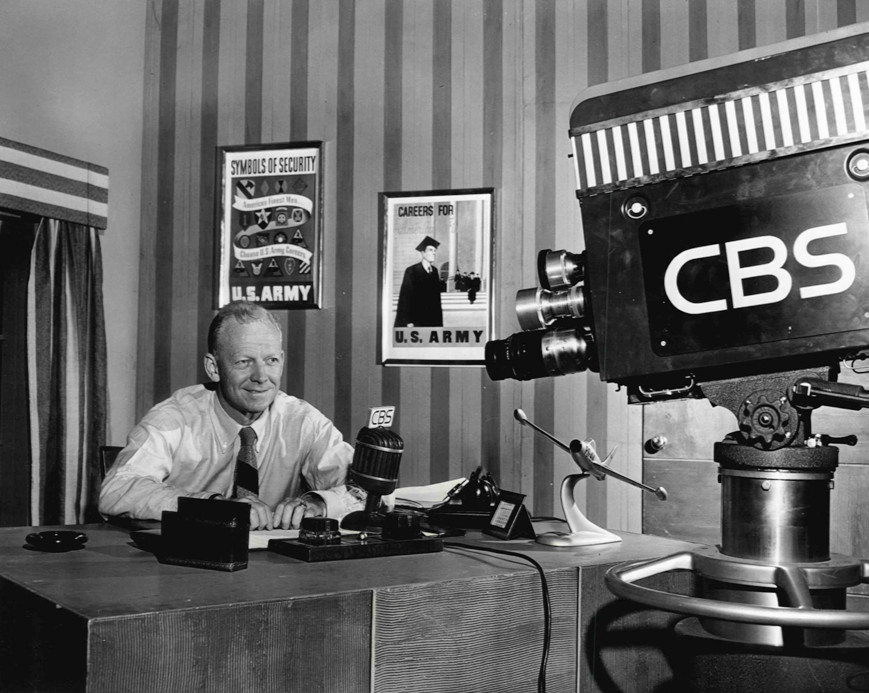
Black-and-white photograph of Red Barber seated behind microphones at a desk facing a CBS television camera
Red Barber in a 1949 CBS publicity photograph for Red Barber’s Club House, ten years after the first major-league telecast. · CBS publicity photograph, via Wikimedia Commons

Monday Reds Firsts

Two Cameras and a Reds Win

On August 26, 1939, the Reds and Dodgers brought major-league baseball to television for the first time. From Ebbets Field, former Cincinnati radio voice Red Barber called the game while two stationary cameras showed the action to viewers in the New York area. The Reds won 5–2, and if you watched closely enough, you might even catch a glimpse of the pitch.

Black-and-white engraving of Cincinnati Red Stockings players and guests gathered around an oversized bat
The Red Stockings’ champion bat presentation, illustrated in Harper’s Weekly on July 24, 1869. · J. A. Gervis, Harper’s Weekly / Library of Congress, Prints and Photographs Division

Sunday Beyond the Diamond

A 27-Foot Welcome Home

When the Cincinnati Red Stockings returned from their Eastern tour on July 1, 1869, a crowd was waiting to welcome them home. A local lumber company joined the celebration with a gift no player could swing: a 27-foot wooden bat bearing the names of all ten players.

Johnny Bench and Sparky Anderson on the field with President Gerald Ford, Darrell Johnson and Thurman Munson before the 1976 All-Star Game
Johnny Bench and Reds manager Sparky Anderson with President Gerald Ford and fellow All-Stars before the 1976 All-Star Game. · Ricardo Thomas / Courtesy Gerald R. Ford Presidential Library, via Wikimedia Commons

Saturday Games to Remember

The Ninth Inning That Won the Pennant

The Reds trailed Pittsburgh 3–2 in the bottom of the ninth at Riverfront Stadium on October 11, 1972, with the pennant on the line. Johnny Bench led off with a home run to right to tie Game 5 of the NLCS. Then pinch runner George Foster raced home on Bob Moose’s wild pitch, sending Cincinnati to the World Series with a 4–3 win.

Black-and-white portrait of Bucky Walters smiling in his Cincinnati Reds cap and uniform
Bucky Walters in a 1940 Cincinnati Reds photograph. · Photographer unknown / Cincinnati Reds, via Wikimedia Commons

Friday Baseball Oddities

A Shutout and a Shot into the Stands

Bucky Walters gave Reds fans two reasons to cheer in Game 6 of the 1940 World Series. He sent the first pitch he saw from Fred Hutchinson into the left-field seats in the eighth, then went back out for the ninth to finish a five-hit shutout. Cincinnati’s 4–0 win over Detroit forced Game 7.

Elly De La Cruz in his Cincinnati Reds uniform before a game against San Diego
Elly De La Cruz before a Reds–Padres game · September 8, 2025 · Reunion / Wikimedia Commons · CC BY 4.0

Bonus Line-up

Today’s Stars. Yesterday’s Legends.

Elly De La Cruz earned Cincinnati’s 2026 Ernie Lombardi MVP Award, Chase Burns the Johnny Vander Meer Outstanding Pitcher Award, and Emilio Pagán the Joe Nuxhall Good Guy Award, as selected by the BBWAA’s Cincinnati chapter. For TRR, those names connect today’s achievements to the history we preserve—from the Lombardi and Vander Meer era in our PC786 postcards to Nuxhall’s enduring place in Cincinnati’s heart. New honors and familiar names keep the Reds story growing.

The Red Room’s framed display featuring a 1975 World Series Game 6 ticket
1975 World Series Game 6 ticket display · The Red Room collection · The Red Room / Collins family archive

Thursday From the Collection

The Pitcher on the Back of the Ticket

The Red Room’s 1975 World Series Game 6 ticket carries another story on its reverse: Luis Tiant’s autograph. Boston’s right-hander opened that Series with a five-hit shutout of Cincinnati, then went the distance again in a 5–4 Game 4 win. Turn a ticket over, and sometimes the opponent’s story is waiting there, too.

Black-and-white photograph of Reds players lined up on the field in front of a packed grandstand
The Cincinnati Reds before a game at Redland Field, circa 1920. · Photographer unknown, via Wikimedia Commons

Wednesday The Ballparks

When Crosley was Redland Field

Cincinnati opened its new ballpark on April 11, 1912, with a 10–6 win over the Chicago Cubs. The Reds clinched their first National League pennant there in 1919, and the park kept the Redland Field name until 1934, when the club renamed it for new owner Powel Crosley Jr.

Edd Roush crouching with his glove on his 1919 postcard
Edd Roush, 1919 PC799 postcard · The Red Room collection

Tuesday The People

Edd Roush, with a bat to match.

Edd Roush used an unusually heavy bat and still had the control to spray hits around the field. He led the National League in batting in 1917 and 1919, the latter the year Cincinnati won its first World Series.