Small discoveries. A deeper appreciation of the game.
Postcards, players, and the history they share. Newest entries first, with sources for further reading.
The opening entries were restored from the original daily messages. October 29–November 1 dates are reconstructed for archive order; November 2–3 delivery dates are confirmed.
Cincinnati shortstop Billy Myers in a period portrait dated circa 1939 by the Wikimedia Commons item record.Photographer unknown / Yi Auctions, via Wikimedia Commons · Photo record
Why Billy Myers Became a Jaguar
Troy, Billy Myers’ place in the PC786 checklist opens the door to Cincinnati’s “Jungle Club.” In 1939, new third baseman Bill Werber urged his fellow infielders to stay lively on the balls of their feet, like jungle cats. Werber became Tiger, second baseman Lonny Frey was Leopard, and shortstop Myers was Jaguar. First baseman Frank McCormick initially missed out because Werber wanted more hustle from him; after raising his energy, he joined as Wildcat. SABR recounts the episode from Werber’s recollections. The animal names were playful, but the point was practical: keep moving and stay ready. Read together, those postcard names introduce an infield whose shared identity grew from the everyday work of fielding.
Frank McCormick’s PC786 postcard illustrates one subject in an issue whose published totals also account for poses, lettering and advertising versions.The Red Room / Collins family archive
A Checklist Total Needs a Counting Rule
Troy, a PC786 checklist total makes more sense when we ask what it counts. Pre-War Cards’ published study describes an earlier 37-card listing that grew to 39 after two discoveries, then gives 46 when pose and lettering variations are included. Sponsor variations add another layer beyond that figure. The first increases reflect newly reported cards; the larger total also changes what is counted. A new pose can earn its own checklist entry without adding another person; a different advertiser can distinguish another version of the same subject. That is why a careful description should state its counting rule. The number alone cannot tell us how many designs were printed—or how many postcards survive.
Lonny Frey in a photographic portrait from the Reds’ 1940 team issue, one season after his change to batting exclusively left-handed.Cincinnati Reds, 1940 team issue / Wikimedia Commons · Photo record
Lonny Frey Picked One Side of the Plate
Troy, the Linus Frey in the Orcajo checklist is the player usually remembered as Lonny—and his 1939 season offers a neat lesson in simplifying a skill. At the start of that year, Bill McKechnie persuaded Frey to stop switch-hitting and bat exclusively left-handed. The manager also encouraged him to pull the ball more. After batting .265 with four home runs in 1938, Cincinnati’s second baseman hit .291 with eleven in the pennant season. Those totals do not prove that one adjustment caused every improvement, but they show what followed the change. Behind a familiar postcard name was an established major leaguer still willing to reshape his approach to help the Reds.
Hank Gowdy with the Boston Braves in a 1914 Bain photograph, well before he joined Cincinnati’s coaching staff in 1938.Bain News Service / Library of Congress, George Grantham Bain Collection, via Wikimedia Commons · Photo record
The Coach Who Had Already Starred in October
Troy, Hank Gowdy’s PC786 postcard introduces a man whose October experience reached well beyond Cincinnati. He joined the Reds’ coaching staff in 1938 and remained there during the 1939 pennant season. A quarter-century earlier, he had been Boston’s catching star in the 1914 World Series, batting .545 as the Braves swept Philadelphia. His home run in Game 3 helped launch a tying rally in the tenth inning; Boston eventually won in the twelfth. That background gives his Orcajo portrait extra meaning. The checklist preserves more than the players taking the field: it also includes a coach who had experienced championship pressure himself, long before Cincinnati’s next pennant arrived.
Bucky Walters in a 1944 Los Angeles Daily News portrait, six years after his trade to Cincinnati.Photographer unknown / Los Angeles Daily News, via Wikimedia Commons · Photo record
The New Red Between Two No-Hitters
Cincinnati added a future ace while Johnny Vander Meer was making history. On June 13, 1938, the Reds acquired Bucky Walters from Philadelphia for pitcher Al Hollingsworth, catcher Spud Davis and cash. Walters arrived between Vander Meer’s consecutive no-hitters and even warmed up in the bullpen during the second one, drawing boos from Brooklyn fans who wanted history to continue. He had gone 4–8 with a 5.23 ERA for the Phillies; with Cincinnati that season, he went 11–6 with a 3.69 ERA. Walters’ place in the Orcajo checklist catches a team still taking shape: the pitcher remembered for the pennant years was already helping Cincinnati improve in 1938.
Cincinnati pitcher Junior Thompson in a 1939 Acme Newspictures press photograph.Acme Newspictures, via Wikimedia Commons · Photo record
Junior Thompson’s First Three Outs
Imagine making your major league debut and seeing Joe Medwick and Johnny Mize waiting to hit. That was Junior Thompson’s introduction on April 26, 1939, when the 21-year-old Reds right-hander entered in the eighth inning at St. Louis. Medwick grounded out, Mize flied to center, and Terry Moore popped to third. Thompson went on to pitch in both the rotation and the bullpen, finishing 13–5 with a 2.54 ERA in his rookie season. His PC786 postcard is a reminder that Cincinnati’s pennant staff had more than two famous aces. Behind Paul Derringer and Bucky Walters was a newcomer who could give Bill McKechnie innings in either role.
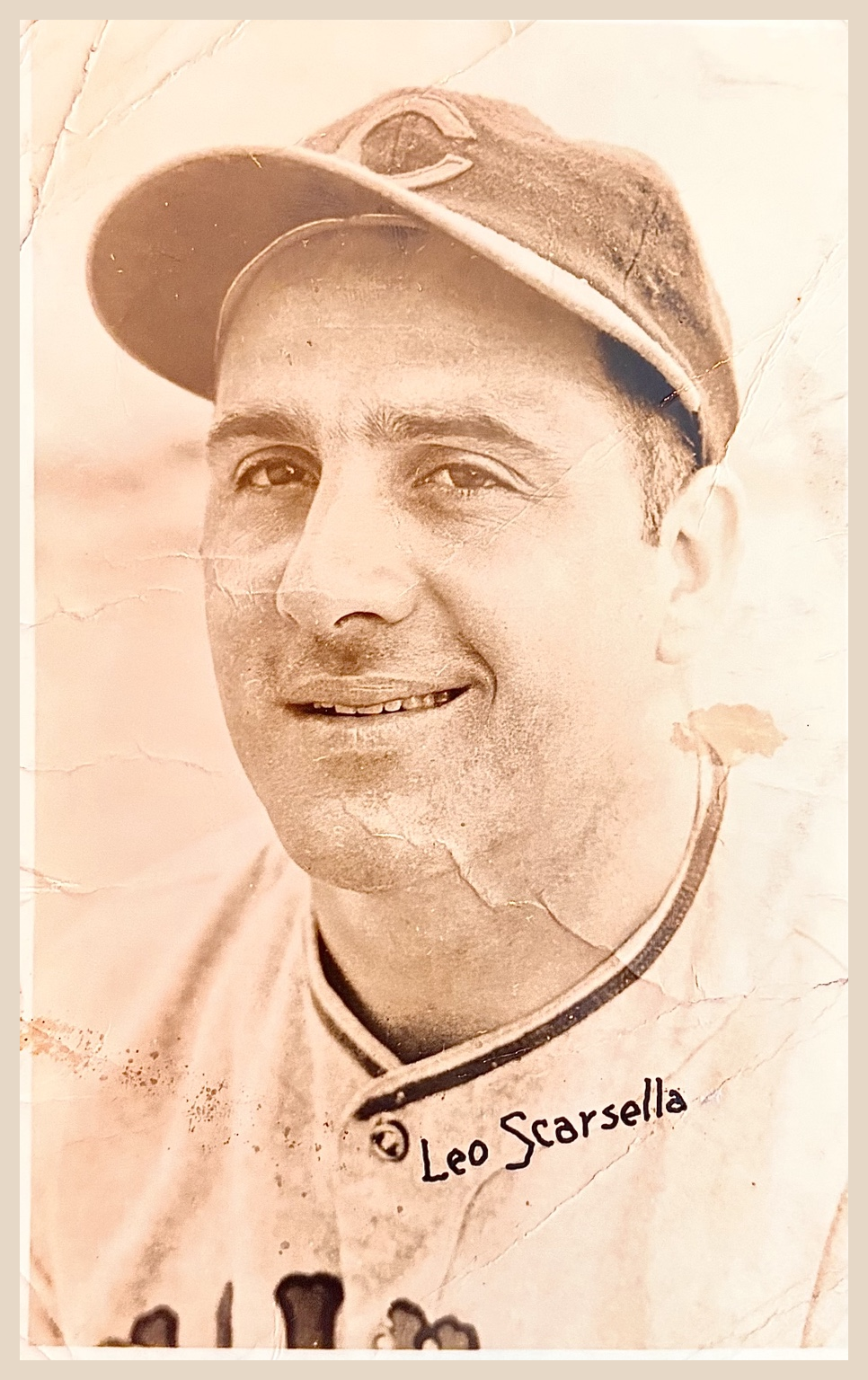
The close-up Orcajo postcard shows Les Scarsella in a Cincinnati cap, with “Leo Scarsella” printed across his jersey.The Red Room / Collins family archive
Two Ways to Picture Les Scarsella
Start with the photograph when comparing the PC786 postcards of Leslie George Scarsella. The Orcajo example shown here frames his face and Reds cap tightly, with “Leo Scarsella” across the jersey. The checklists also describe a WHIO version labeled “Les Scarsella” that shows him from farther back, roughly from the waist up. It’s the same player, pictured at two different distances. His playing record adds another useful clue: Scarsella appeared in 110 games for Cincinnati in 1937, spent 1938 with the Newark Bears, and returned to the Reds in 1939. A Cincinnati uniform identifies the club he’s pictured with, but it can’t, by itself, settle when a postcard was printed.
Willard Hershberger draws back his throwing arm in catcher’s gear in this 1939 Acme press photograph.Acme Newspictures, via Wikimedia Commons · Photo record
The Backup Catcher Who Tied Game 4
Willard Hershberger backed up Ernie Lombardi in 1939, but he gave the pennant-winning Reds a good reason to keep his bat handy: he hit .345 in 63 games. In Game 4 of the World Series on October 8 at Crosley Field, Cincinnati trailed the Yankees 2–1 with two outs in the seventh. Hershberger pinch-hit for pitcher Paul Derringer and singled home Al Simmons to tie it. Bill Werber followed with a single that put the Reds ahead. The Yankees won 7–4 in ten innings, but Hershberger’s PC786 postcard gives us a reason to linger on the seventh: Cincinnati’s backup catcher helped turn a two-run deficit into a lead.
Bill Werber in his Reds uniform in a 1940 club photograph, one season after he led the National League in runs scored.Photographer unknown / Cincinnati Reds, via Wikimedia Commons · Photo record
Bill Werber Set the Table for the 1939 Reds
On March 16, 1939, the Philadelphia Athletics sold third baseman Bill Werber to Cincinnati. By season’s end, the new Reds leadoff man had scored 115 runs, more than anyone else in the National League. His .289 batting average tells only part of the story: he also drew 91 walks, helping him reach base at a .388 clip. For a pennant club with hitters like Ival Goodman and Ernie Lombardi, that meant more chances to bat with someone aboard. The next time you spot Werber in the Orcajo checklist, think about what happened before the big hit: somebody had to get on first.
Ernie Lombardi in catcher’s gear in a 1940 Cincinnati Reds photograph, three seasons after his six-hit game.Cincinnati Reds photograph / Wikimedia Commons · Photo record
Six Trips to the Plate, Six Hits for Ernie Lombardi
On May 9, 1937, Ernie Lombardi came to bat six times at Philadelphia’s Baker Bowl and got a hit every time. The Reds catcher drove in five runs and scored three in a 21–10 win. He wasn’t the only one keeping the scorekeeper busy: second baseman Alex Kampouris hit three home runs, including a grand slam, and drove in eight. Cincinnati finished last that year, which makes it easy to overlook afternoons like this one. The Orcajo checklist includes both hitters, and this box score lets you put their postcards side by side with a reason: together they drove in 13 of the Reds’ 21 runs.
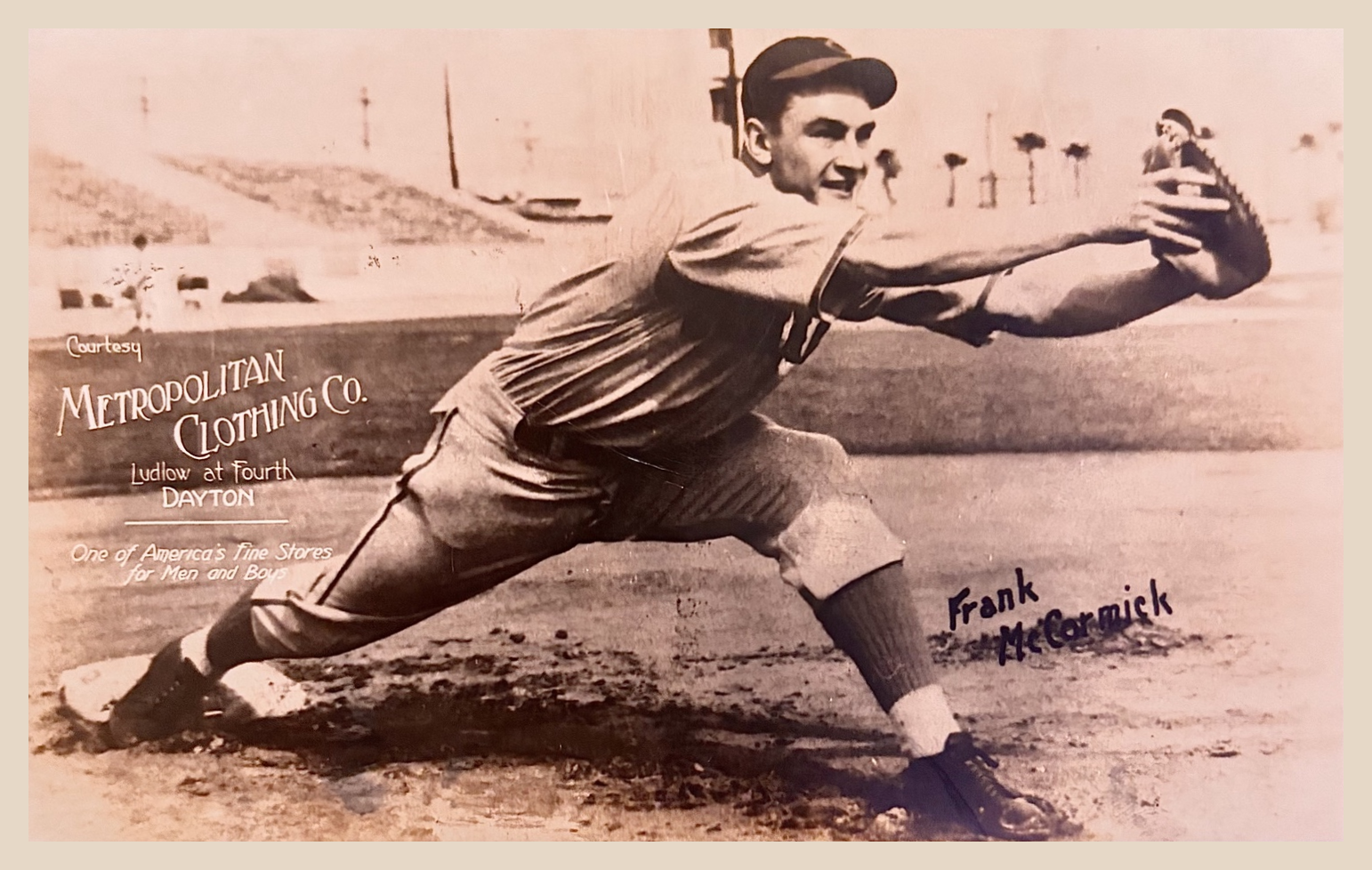
Frank McCormick stretches for a catch on the Metropolitan Clothing Co. version of his Orcajo postcard. The advertisement appears at left.The Red Room / Collins family archive
Frank McCormick’s Postcard Had Room for an Ad
Look to the left of Frank McCormick’s outstretched glove on this Orcajo postcard and you’ll find a clothing-store advertisement worked into the picture. It names Metropolitan Clothing Co., but that’s only one of three documented fronts for McCormick. Another carries Val Decker Packing Co. advertising, and a third carries his name without an ad. Catalog researcher Bob Lemke notes that all three types carry the Orcajo Photo Art credit on the back. That gives each side a different job: the front identifies the ballplayer and, sometimes, an advertiser; the back identifies the Dayton studio. The advertisement tells you which business is named, but it doesn’t tell you exactly when or where a particular postcard was handed out.
Reds manager Bill McKechnie (right, in uniform) beside club owner Powel Crosley Jr., circa 1940.Herb Heise / The Cincinnati Enquirer, via Wikimedia Commons · Photo record
How Bill McKechnie Took the Reds From Last to First
Bill McKechnie took over a Cincinnati team that had finished last in 1937. In his first season, the Reds went 82–68 and climbed to fourth. A year later, his emphasis on pitching and defense was on display in the pennant clincher: on September 28, 1939, Ernie Lombardi picked a runner off second, Lonny Frey and Billy Myers turned a double play, and Paul Derringer finished a 5–3 win over St. Louis. McKechnie became the first manager to win National League pennants with three clubs, having already done it with Pittsburgh and St. Louis. His Orcajo postcard is a good reminder to look at the man on the bench as well as the players on the field.
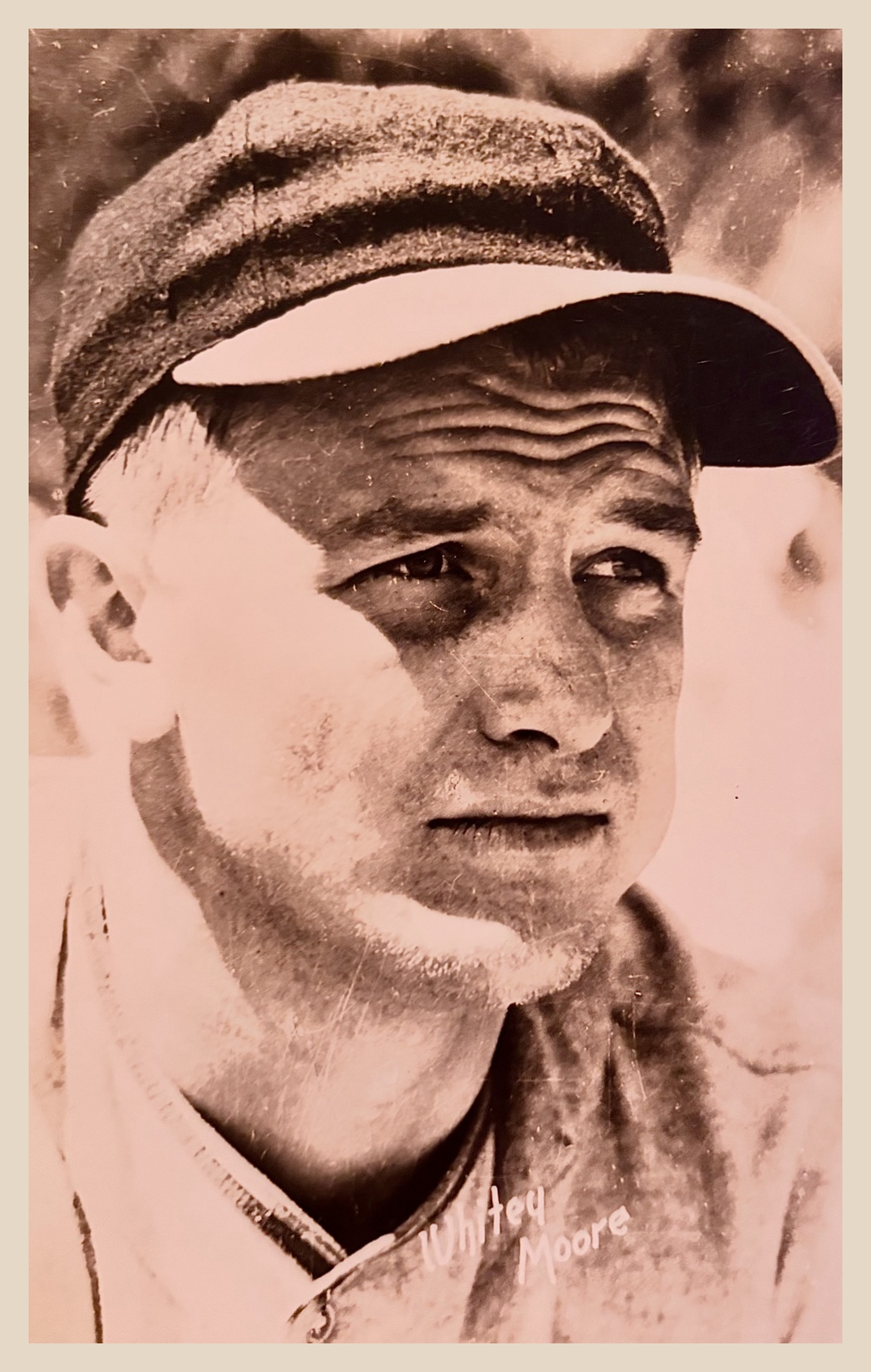
The PC786 Whitey Moore postcard that shows Moore himself. The other documented version shows Bucky Walters under Moore’s name.The Red Room / Collins family archive
The Whitey Moore Postcard With Another Pitcher’s Face
Two Orcajo postcards carry Whitey Moore’s name, but only one shows Moore. The PC786 checklist records a version picturing his Cincinnati teammate Bucky Walters, alongside the version with Moore’s own portrait shown here. The two right-handers did very different work for the 1939 pennant winners: Walters won 27 games, while Moore won 13 in 42 appearances, 24 of them starts. Moore also retired all nine Yankees he faced in relief in Game 3 of that fall’s World Series. When you compare the postcards, record the printed name and the pictured player separately. Both versions tell you something about how the issue was made, and the correct portrait gives Moore his due for the innings he pitched.
Ival Goodman in a portrait photograph published in Cincinnati’s 1940 team issue, separate from his Orcajo postcard.Cincinnati Reds 1940 team issue, published by Harry Hartman Publishing Company / Wikimedia Commons · Photo record
Ival Goodman’s Summer of 30 Home Runs
Ival Goodman led Cincinnati in doubles and triples in 1937, when the Reds finished last. A year later, the same right fielder became the first Red to hit 30 home runs in a season, clearing the old club record by 11. Cincinnati climbed to fourth place in 1938, and only Mel Ott hit more homers in the National League that year. Then came a twist: Goodman hit just seven homers in 1939, but he batted a career-best .323 and added 37 doubles and 16 triples for the pennant winners. That’s what makes his place in the Orcajo checklist so rewarding: the postcard introduces a hitter who helped the Reds climb the standings in more than one way.
Harry Craft in a Cincinnati Reds team-issue portrait from 1940, separate from his Orcajo postcard.Harry Hartman Publishing Company / Cincinnati Reds team issue, via Wikimedia Commons · Photo record
How Harry Craft Made Center Field His Own
Harry Craft introduced himself to Cincinnati with a triple and two singles in his major-league debut on September 19, 1937. But his glove is what made him such a good fit for the rising Reds. He led National League outfielders in putouts in both 1938 and 1939, and in the pennant season he also led the league’s center fielders in double plays. A putout can be as simple as catching a fly ball, but doing it that often tells you how much ground a regular center fielder can cover. Craft’s place in the Orcajo checklist is a reminder to look beyond the batting line when getting to know the 1939 club.
Frank McCormick in a Cincinnati Reds team-issue portrait, circa 1940. This is separate from his Orcajo postcard.Cincinnati Reds team issue / Wikimedia Commons · Photo record
Frank McCormick’s Two Seasons of 209 Hits
Frank “Buck” McCormick got another look with Cincinnati in 1937, then won the first-base job in spring training in 1938. He promptly led the National League with 209 hits. In 1939 he led the league with exactly 209 again, added a league-best 128 runs batted in, and helped the Reds win their first pennant in 20 years. The matching hit totals make a neat pair, but the team’s rise is the better story: in two seasons, McCormick went from trying to earn a regular job to anchoring the lineup of a pennant winner. That’s the stretch of Reds history behind his Orcajo postcard.
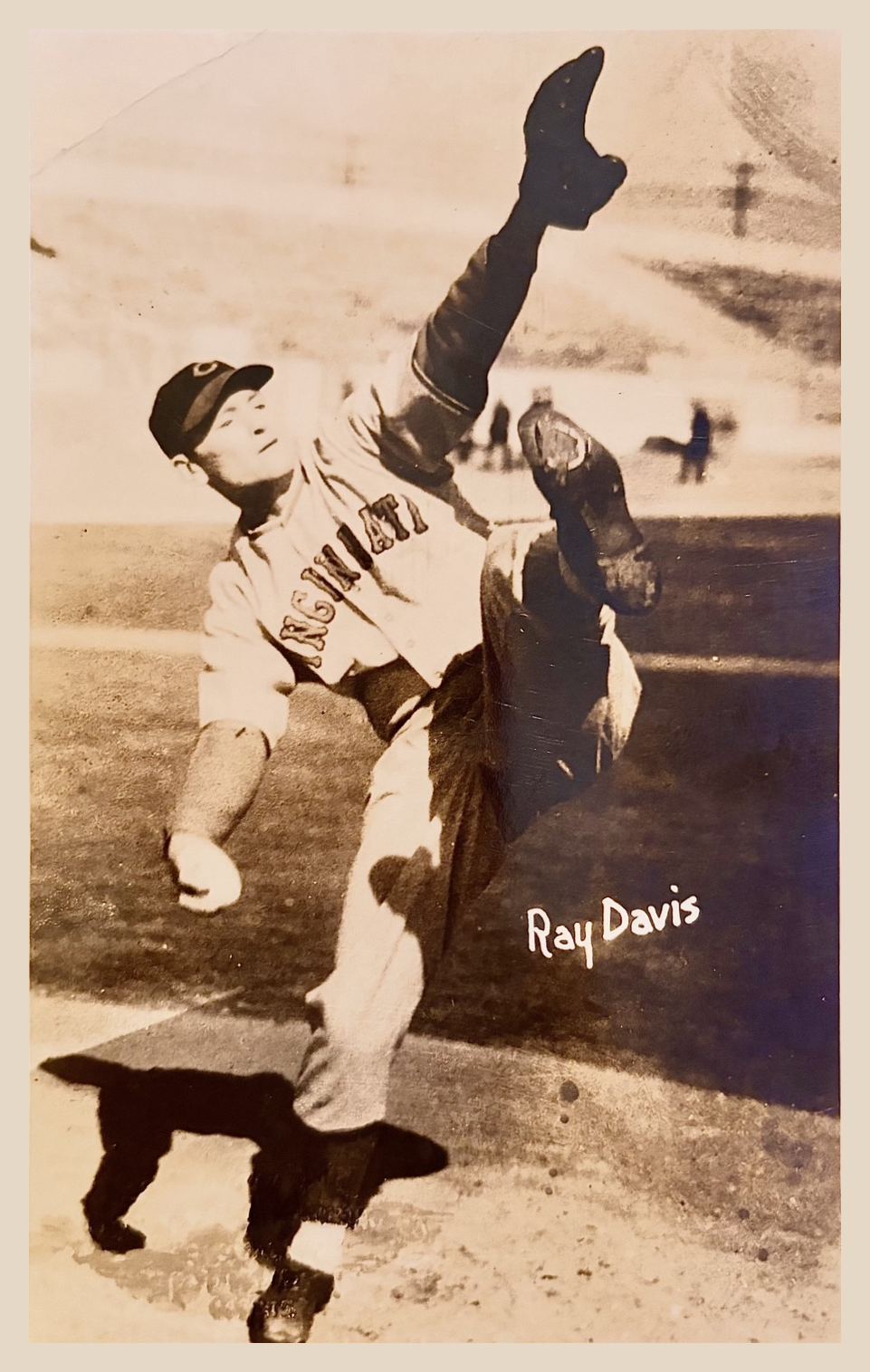
Roy “Peaches” Davis’s PC786 postcard, the subject identified as “Ray” in the issue’s published research.The Red Room / Collins family archive
Three Davises—and one misleading first name
A PC786 postcard labeled “Ray Davis” introduces a small but useful identification puzzle: the pitcher was Roy “Peaches” Davis. Catalog editor Bob Lemke documented that printed-name discrepancy in his 2011 study, distinguishing the pitcher from two other Davises in the Orcajo group: George “Kiddo” Davis and catcher Virgil “Spud” Davis. Those nicknames are more than colorful baseball language; they help keep three different Reds straight when reading a checklist. Lemke reported Kiddo’s newly documented postcard with Val Decker advertising, while the pitcher appears under “Ray” in the Pre-War Cards checklist. The lesson is to record what the postcard actually says while separately identifying its subject correctly. An old printed caption is evidence to examine, not an infallible biography.
Johnny Vander Meer (left) with Babe Ruth in a 1938 newspaper photograph.Indianapolis Times / Indiana State Library, via Wikimedia Commons · Photo record
Vander Meer got the All-Star start at home
Johnny Vander Meer’s consecutive no-hitters in June 1938 tend to get the whole spotlight, but his July 6 start at Crosley Field deserves a look of its own. With his parents in the stands, the Reds left-hander held the American League to one hit in three scoreless innings and struck out Jimmie Foxx. Fellow Red Ernie Lombardi singled home Mel Ott in the fourth, and the National League won 4–1, with Vander Meer getting the win. The PC786 checklist records a horizontal throwing pose for Vander Meer. That pose is a good prompt to remember the summer Cincinnati fans got to see their own pitcher take the mound against the best of the other league.
For comparison: the reverse of a plain Orcajo Lee Grissom postcard, not a WHIO example.Image: The Red Room / Collins family archive
The WHIO cards have a different calling card
A PC786 postcard can belong to the cataloged group without carrying an Orcajo imprint on its back. In his March 30, 2011, study, catalog editor Bob Lemke identified the WHIO type by its inset photograph of Reds broadcaster Si Burick on the front—and noted that these cards lack the Orcajo credit on the reverse. The other three types he described—plain-front, Val Decker, and Metropolitan Clothing—carry “ORCAJO PHOTO ART, DAYTON, OHIO.” Lemke dated the WHIO cards to 1937, while treating a 1937 start for the other types as tentative. The lesson: PC786 groups related designs with meaningful differences. Examine both sides before expecting every example to follow one template.
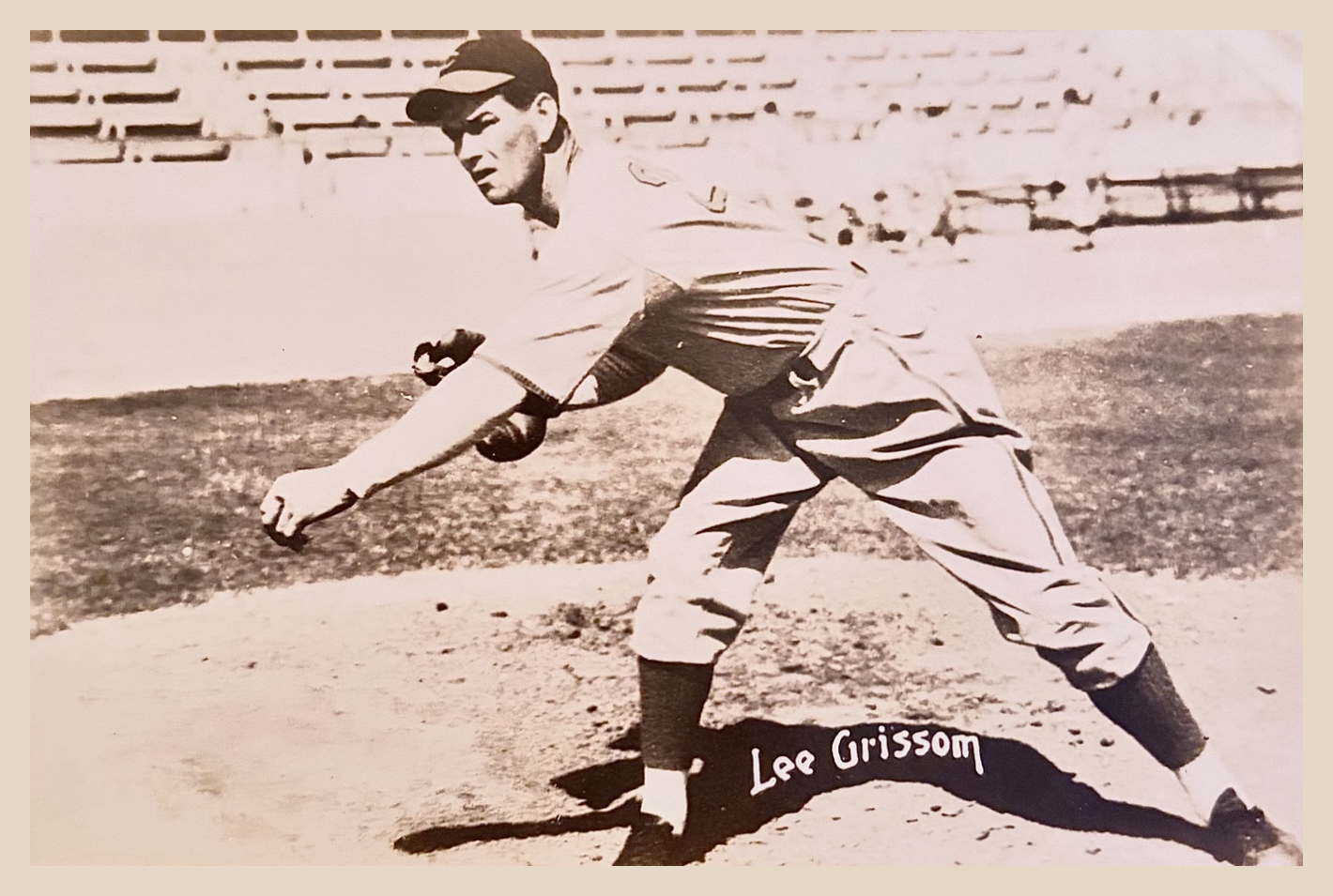
Lee Grissom’s PC786 pitching portrait.Image: The Red Room / Collins family archive
Lee Grissom’s memorable All-Star entrance
Lee Grissom began his only All-Star Game appearance by striking out Lou Gehrig and Earl Averill back-to-back. National League manager Bill Terry selected the left-hander, whose ability he knew from facing Cincinnati. Entering in the fifth inning, Grissom promptly retired those two formidable hitters on strikes. Reality then interrupted: Joe Cronin and Bill Dickey hit consecutive doubles before Grissom ended the inning by retiring Sam West. His season deserves attention beyond that cameo—he led the league in shutouts while working as both a starter and reliever. It’s a useful reminder when studying the PC786 era: even Cincinnati’s difficult 1937 season contained individual performances worth celebrating.
Lee Grissom’s Orcajo portrait connects a face with his substantial 1937 workload.Image: The Red Room / Collins family archive
Reconstructed archive date
Grissom’s record hides a terrific 1937 season
Lee Grissom offers a good reminder to look beyond a pitcher’s wins and losses. In 1937, the Reds left-hander finished 12–17, yet threw five shutouts and struck out 149 batters in 223⅔ innings. He worked in 50 games, starting 30—a substantial workload across two roles. Those numbers reveal considerably more than that losing record suggests.
National League All-Star manager Bill Terry recognized his ability. In Grissom’s only major-league All-Star appearance, he entered in the fifth inning and struck out his first two opponents: Lou Gehrig and Earl Averill. Consecutive doubles followed, so it wasn’t a spotless outing, but that opening pair of strikeouts makes a memorable introduction! Behind the PC786 portrait was a pitcher whose best season deserves a closer look.
Ernie Lombardi in a 1940 Cincinnati Reds photograph, separate from his Orcajo postcards.Cincinnati Reds photograph / Wikimedia Commons · Photo recordCompare the Orcajo postcard
Reconstructed archive date
Lombardi’s lettering is part of the story
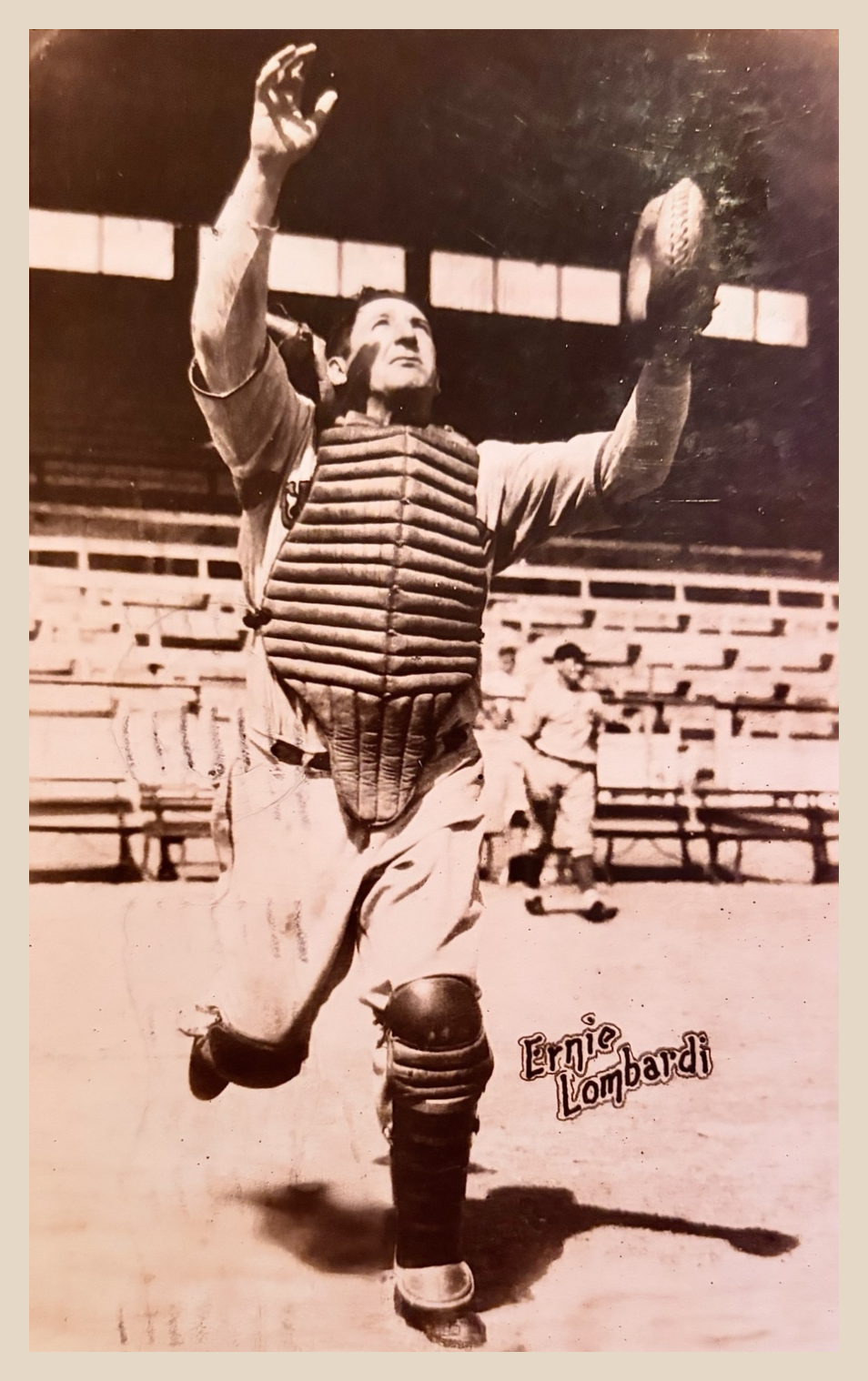
Even the lettering beneath a photograph can be a useful clue. Ernie Lombardi’s PC786 postcards appear with plain lettering and with outlined, “fancy” lettering. The interesting wrinkle is how those designs pair with sponsors. The researcher behind Pre-War Cards reports personally seeing plain-lettered examples with Val Decker advertising, and fancy-lettered examples with Orcajo or Metropolitan identification. The Standard Catalog lists additional combinations that the researcher could not confirm.
That distinction matters: a catalog listing and an examined example are different kinds of evidence. It does not prove the other combinations never existed; it tells us which remain unconfirmed in that researcher’s account. Studying PC786 means reading the photograph, lettering and advertising together—each contributes to identifying the particular version.
Lee Grissom in his PC786 pitching pose.Image: The Red Room / Collins family archive
Reconstructed archive date
Lee Grissom’s two-batter brush with greatness
Before the later pennant-winning Reds took shape, PC786 subject Lee Grissom enjoyed a memorable moment in the 1937 All-Star Game. On July 7 at Washington’s Griffith Stadium, the Cincinnati left-hander entered in the fifth inning and struck out his first two opponents: Lou Gehrig and Earl Averill. That is quite an entrance! Consecutive doubles by Joe Cronin and Bill Dickey then produced a run before Grissom retired Sam West. It was his only major-league All-Star appearance. Manager Bill Terry had selected him, and that brief outing captures why: Grissom could challenge outstanding hitters, even if he couldn’t keep the entire lineup quiet. His Orcajo portrait represents a pitcher who earned a place among the game’s stars in 1937.
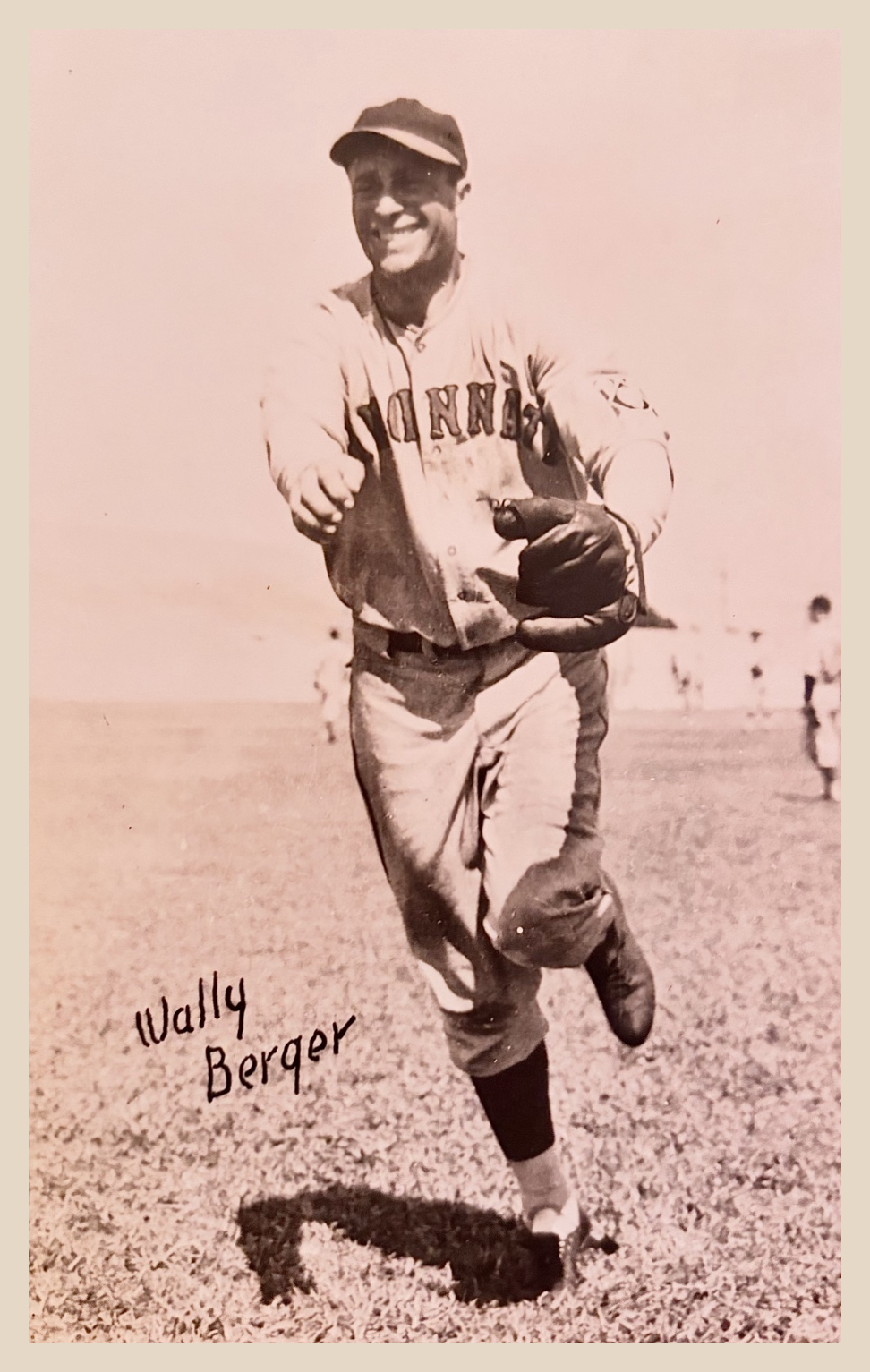
Wally Berger on an Orcajo postcard—the player Cincinnati received in the Kampouris trade.Image: The Red Room / Collins family archive
Reconstructed archive date
Two postcards, opposite sides of one trade
Alex Kampouris and Wally Berger both appear in the Orcajo issue—but Cincinnati traded one for the other. On June 6, 1938, the Reds sent Kampouris to the Giants for Berger. Reunited with manager Bill McKechnie, Berger hit .307 with 16 home runs and 56 RBIs in 99 Cincinnati games that season. Their inclusion helps explain why treating PC786 as one fixed “1939 team set” can be misleading: its subjects span a changing roster. Catalog researcher Bob Lemke documented a Kampouris example in 2011 with badly faded Val Decker advertising. The useful lesson is to separate a photograph’s likely timeframe, a player’s Reds tenure and the postcard’s actual production date—those aren’t automatically identical.