Small discoveries. A deeper appreciation of the game.
Postcards, players, and the history they share. Newest entries first, with sources for further reading.
The opening entries were restored from the original daily messages. October 29–November 1 dates are reconstructed for archive order; November 2–3 delivery dates are confirmed.
Pat Moran in Cincinnati uniform in a Bain photograph dated 1919 by the Library of Congress.Bain News Service / Library of Congress, George Grantham Bain Collection, via Wikimedia Commons · Photo record
Pat Moran’s Infield Took More Than One Deal
Pat Moran’s PC799 postcard represents a manager whose championship infield took some assembling. In February 1919, Cincinnati sent Larry Kopf and Tom Griffith to Brooklyn in the deal for first baseman Jake Daubert. Kopf refused to report. That might sound like the end of his Cincinnati story, but Moran brought him back in exchange for Lee Magee. An April 19 newspaper report described the return deal and said both players had accepted terms. With Morrie Rath brought up from the minors to cover second base, the Reds had reshaped the middle and right side of their infield. The lesson behind the championship portraits is a lively one: a finished team photograph can conceal a spring full of negotiations and changing plans.
Hank Schreiber appears in the published PC799 checklist; the issue does not include every player who appeared for the Reds during 1919.The Red Room / Collins family archive
A Championship Checklist Is Not a Season Roster
The PC799 postcards commemorate a team, but their checklist is not a roll call of everyone who played for Cincinnati in 1919. Manuel Cueto appeared in 29 games that season, yet he is absent from Old Cardboard’s published 24-subject gallery. Hank Schreiber, pictured here, played in 19 games and does appear. Cueto’s last major league appearance came on June 25, months before the championship—a useful piece of context, but not proof of why he was omitted. The checklist itself does not explain that decision. Comparing postcards with playing records lets us appreciate both what the issue preserves and what it leaves outside the frame, without inventing a publisher’s reasoning.
Nick Allen’s PC799 championship postcard, identifying one of Cincinnati’s reserve catchers.The Red Room / Collins family archive
Nick Allen’s .320 Needs a Second Number
Nick Allen’s PC799 postcard opens a useful window on the quieter jobs inside a championship team. Behind Ivey Wingo and Bill Rariden, Allen served mainly as Cincinnati’s bullpen catcher in 1919. He appeared in only 15 games, yet finished with a sparkling .320 batting average. The essential companion number is 25: that was his entire at-bat total, producing eight hits. One fewer hit would have meant .280; one more would have meant .360. That small calculation explains why averages from short stints deserve care. Allen’s postcard preserves a genuine team member whose principal work happened away from the everyday lineup, while his batting line teaches us to ask how many chances stand behind a percentage.
Cincinnati shortstop Larry Kopf in a Bain photograph dated 1919 by the Library of Congress.Bain News Service / Library of Congress, George Grantham Bain Collection, via Wikimedia Commons · Photo record
Fifty-Eight Runs Batted In, Without a Homer
Larry Kopf’s PC799 portrait is a good reminder that a championship offense needs more than home-run hitters. Cincinnati’s switch-hitting shortstop batted .270 in 1919 and drove in 58 runs without hitting a single homer. SABR places that RBI total third on the Reds and tenth in the National League. His season included 18 doubles and five triples, so “no home runs” certainly did not mean “no extra-base hits.” That is a useful way to read this championship checklist: alongside the famous names are players whose everyday contributions helped the team win. Kopf’s numbers invite us to picture a different kind of run production, built without the modern expectation that a productive hitter must regularly clear the fence.
Ivey Wingo poses with a ball and catcher’s mitt in a 1924 Bain photograph, five years after Cincinnati’s championship season.Bain News Service / Library of Congress, George Grantham Bain Collection, via Wikimedia Commons · Photo record
Two Catchers, One Useful Matchup
Ivey Wingo and Bill Rariden both appear in the PC799 championship postcards, and their shared job tells us something useful about Pat Moran’s 1919 Reds. Wingo batted left-handed and generally caught against right-handed starters; Rariden generally played against left-handers. Rather than treating one catcher as the everyday answer, Moran could choose the bat that suited the matchup. Wingo supplied a memorable example in World Series Game 7 against right-hander Eddie Cicotte: he singled in his only official at-bat and drew three walks. Cincinnati lost 4–1, but Wingo reached base four times. Put the two catchers’ names together, and the postcard checklist becomes a small lesson in how a manager could get more from his roster.
Roy Mitchell’s PC799 postcard shows his hands raised in a pitching pose, with pale margins along both sides of the photograph.The Red Room / Collins family archive
A Little White Space on the 1919 Postcards
Look at the sides of Roy Mitchell’s PC799 postcard before you read the caption. A pale strip runs down each edge, framing the pitcher as he raises both hands over his head. Old Cardboard documents that treatment on four subjects: Mitchell, Larry Kopf, Bill Rariden, and Walter “Dutch” Ruether. On a typical example such as Edd Roush’s, the photograph runs right out to the side edges. Both layouts fit the same standard 3½-by-5½-inch postcard format. That makes the side margins a useful clue when comparing fronts: the extra white space on Mitchell’s card is part of the documented design, and it gives the windup a little more room to breathe.
Jimmy Ring is second from the right in the back row of this Cincinnati team photograph, published in The Daily Ardmoreite on October 15, 1919.Press Illustrating Service / The Daily Ardmoreite, via Library of Congress and Wikimedia Commons · Photo record
Jimmy Ring and the Ground Ball That Saved the Shutout
Jimmy Ring was one of six Reds pitchers to win at least ten games in 1919, and his World Series start showed why that depth mattered. In Game 4 at Chicago’s Comiskey Park on October 4, the White Sox loaded the bases in the second inning. Ring got pitcher Eddie Cicotte to ground to second baseman Morrie Rath, who threw to Jake Daubert to end the inning. Cincinnati scored twice in the fifth, and Ring made those runs stand up, allowing just three hits in a 2–0 shutout that gave the Reds a three-games-to-one lead. His PC799 postcard puts a face to the box score, and that early grounder shows how much a shutout can owe to the fielders behind the pitcher.
Eddie Gerner’s PC799 postcard shows him in a pitching pose and identifies him as a pitcher.The Red Room / Collins family archive
Eddie Gerner’s One Start and One Big Double
Eddie Gerner’s PC799 postcard labels him a pitcher, which makes the box score from July 28, 1919, a fun companion. In his only major league start, the left-hander pitched eight innings against Pittsburgh and drove in two runs himself. One came on a fifth-inning double off Hal Carlson, the only hit of Gerner’s big league career. The Reds won 8–7, so those two runs mattered. Gerner later became an outfielder and cleanup hitter in semipro ball, commuting from Philadelphia to play for Brooklyn clubs. The postcard’s caption tells you what he did for the 1919 Reds. That one afternoon with the bat gives you an early glimpse of the player he would become.
The Sun’s October 2, 1919 sports page features Dutch Ruether at center, with Reds teammates Jake Daubert and Greasy Neale.The Sun (New York), October 2, 1919, p. 18 / Wikimedia Commons · Photo record
Dutch Ruether Won Game 1 With His Arm and His Bat
Dutch Ruether went 19–6 with a 1.82 ERA in 1919, so he was a natural choice to start Cincinnati’s first World Series game. On October 1 at Redland Field, the lefty held the White Sox to six singles and pitched all nine innings of a 9–1 Reds win. He also went 3-for-3 with two triples, a walk, and three runs batted in. His first triple struck the temporary wire fence that held back the overflow crowd and brought home two runners. The championship postcard series includes Ruether as a pitcher, but the next morning’s sports page gives his bat just as much room as his arm.
Rube Bressler in a period Sporting News portrait dated circa 1917–1920; the exact season is unidentified.Photographer unknown / The Sporting News, via Wikimedia Commons · Photo record
Rube Bressler’s World Series Work Came Before First Pitch
When outfielder Sherry Magee fell ill in 1919, Reds manager Pat Moran tried left-handed pitcher Rube Bressler in the outfield. Center fielder Edd Roush helped him learn the position, and Bressler played 48 games in the outfield that season. He never appeared in the World Series box scores, but he still got to use his pitching arm: he threw batting practice to help Cincinnati’s hitters prepare for Chicago lefties Lefty Williams and Dickey Kerr. That makes Bressler an especially good name to find on the PC799 championship checklist. The postcard gives him a place among the champions; the story behind it shows how a teammate can help win a title before the game even starts.
Slim Sallee with the New York Giants in 1917, two seasons before his 21-win year with Cincinnati.Bain News Service / Library of Congress, George Grantham Bain Collection, via Wikimedia Commons · Photo record
Slim Sallee Won More Games Than He Issued Walks
Harry “Slim” Sallee’s 1919 pitching line has a pair of numbers worth reading twice: 21 wins and only 20 walks. The Cincinnati left-hander threw 227⅔ innings, struck out 24 batters, and finished 22 of his 28 starts. The figures go together: he could work deep into games without many strikeouts because he made hitters put the ball in play and rarely gave them first base for free. In Game 2 of the World Series, he went all nine innings and walked just one batter in a 4–2 Reds win. His PC799 postcard gives us the pitcher’s face; the box scores show how much a championship club could get from throwing strikes and trusting its fielders.
Pat Duncan in a Cincinnati Reds uniform in 1919, photographed by the Bain News Service.Bain News Service / Library of Congress, George Grantham Bain Collection, via Wikimedia Commons · Photo record
Pat Duncan Arrived in August and Drove In Eight in October
In August 1919, the first-place Reds needed outfield help and brought up Pat Duncan from the Birmingham Barons, where he was batting .323. He made three pinch-hit appearances in his first ten days with Cincinnati before getting his first Reds start on August 26 against Philadelphia. By October, Duncan was the left fielder in all eight World Series games. He handled his chances without an error and drove in eight runs, more than any other Red in the Series. His PC799 postcard puts him among the champions, and the calendar tells you just how quickly he earned that place: in less than two months, he went from a minor-league lineup to a regular spot in Cincinnati’s World Series outfield.
Greasy Neale with the Cincinnati Reds in 1919, from a Bain News Service glass negative.Bain News Service / Library of Congress, George Grantham Bain Collection, via Wikimedia Commons · Photo record
Ten October Hits for Greasy Neale
Greasy Neale hit .242 as Cincinnati’s regular right fielder in 1919, but the World Series gave him a fresh start. He collected three hits in the Reds’ 9–1 win in Game 1, then singled home Edd Roush in the sixth inning of Game 2, adding a run in a game Cincinnati won 4–2. Neale finished the eight-game Series with 10 hits in 28 at-bats, a .357 average, and nobody on the Reds had more hits. His PC799 postcard identifies him by his spot in the outfield. The October box scores add another detail: over those eight games, the everyday right fielder was one of Cincinnati’s toughest outs.
Morrie Rath with Cincinnati in 1919, photographed by the Bain News Service.Bain News Service / Library of Congress, George Grantham Bain Collection, via Wikimedia Commons · Photo record
How Morrie Rath Got the 1919 Reds Started
The second baseman on the PC799 postcard was also the man Cincinnati sent up first. Morrie Rath batted .264 in 1919, but his .343 on-base percentage tells you more about why he fit the leadoff spot. He drew 64 walks and scored 77 runs for the pennant winners. The distinction is easy to see: a walk leaves a player’s batting average alone, but it still puts a runner on for the hitters behind him. Rath had already shown how much he could do without home-run power: in 1917, he won the Pacific Coast League batting title at .341 without hitting a single homer. His postcard gives a face to one of the simplest jobs in baseball, and one of the most valuable: get on base.
Ray Fisher with New York’s American League club in 1912, seven years before he pitched for the 1919 Reds.Bain News Service / Library of Congress, George Grantham Bain Collection, via Wikimedia Commons · Photo record
Ray Fisher’s Return to the Mound
Ray Fisher missed the entire 1918 major-league season while serving in the Army. While he was in uniform, Cincinnati acquired him from New York, so his return in 1919 meant learning a new league as well as getting back into pitching shape. He went 14–5 with a 2.17 ERA and threw five shutouts for the pennant winners. Fisher later recalled that the year away had given him a chance to regain his health. His PC799 postcard records where he ended up; that season’s pitching line shows how much he gave Cincinnati in his first year back. A championship staff has room for more than one comeback story.
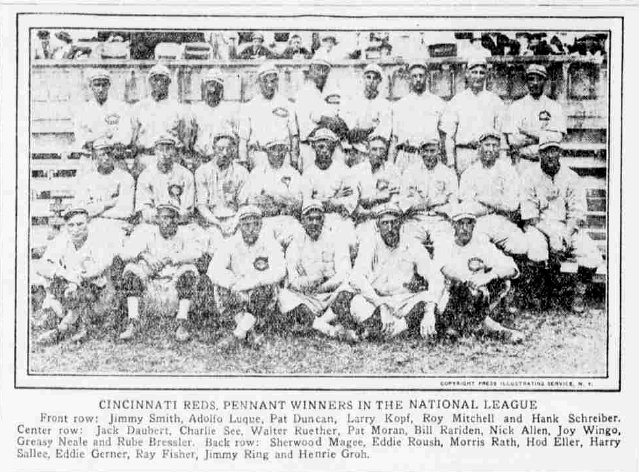
The 1919 Cincinnati Reds in a team portrait published in the Daily Ardmoreite on October 15, 1919.Press Illustrating Service / Wikimedia Commons · Photo record
The September Win Behind the Pennant Caption
Before the 1919 Reds had a World Series to play, they had a pennant to clinch. On September 16 at Redland Field, Cincinnati beat the New York Giants 4–3 to secure its first National League flag. Dutch Ruether pitched all nine innings, working around 12 hits, and the losing pitcher was former Red Fred Toney. Cincinnati went on to finish the regular season 96–44. That September afternoon gives the National League championship wording on PC799 a game to remember: before the October celebration, the Reds had already earned a championship of their own by finishing atop the league. The pennant caption preserves that achievement in a single line.
Edd Roush’s PC799 postcard, one of the 24 subjects documented in the issue’s checklist.The Red Room / Collins family archive
A 1919 team, a 1971 checklist
The players belong to 1919, but documenting their postcards has its own later history. Old Cardboard’s July 2007 study credits Dan Dischley, editor of The Trader Speaks, with publishing PC799’s first checklist in the May 15, 1971, issue. It also reports that Dischley then knew of just four collectors who had possessed examples: himself, James Elder, Wirt Gammon and Al Peterjohn. That describes the circle of knowledge reported at the time—not the number of postcards printed or surviving. It’s a useful distinction when reading early hobby literature. The 24-subject issue gives us a championship roster in pictures; the checklist’s history shows how researchers gradually made those scattered pictures understandable as a group.
Dolf Luque with Cincinnati in 1919, from a Bain News Service glass negative.Bain News Service / Library of Congress, George Grantham Bain Collection · Photo record
Dolf Luque made history out of the bullpen
Adolfo “Dolf” Luque’s place in the PC799 set points to a milestone that doesn’t show up in the final score. In Game 3 of the 1919 World Series, the Cuban pitcher came out of Cincinnati’s bullpen and worked a scoreless inning against the White Sox, becoming the first player born in Latin America to appear in a World Series. Across two relief outings that fall, he allowed one hit and struck out six in five scoreless innings. Luque later won 27 games as a Reds starter in 1923, but his contribution to Cincinnati’s first championship came in relief. His postcard is a reminder of how much history can fit into one inning.
Jake Daubert’s PC799 postcard: notice the caption within the image at the top.Image: The Red Room / Collins family archive
Jake Daubert breaks the caption rule
Look closely at PC799’s lettering and Jake Daubert becomes the layout exception. Old Cardboard’s July 2007 study describes the usual arrangement as two caption lines in a white panel beneath the photograph: the player’s name in bold capitals, his position in smaller italics, and the championship identification below. Daubert’s labeling instead appears within the photographic background at the top. That makes him especially useful for learning the issue’s visual vocabulary: an authentic design need not match every teammate’s layout. The same study identifies four subjects with white borders down both sides—Larry Kopf, Roy Mitchell, Bill Rariden, and Walter Ruether. These documented differences are why comparisons should begin with the same subject, rather than assuming one card establishes the design rules for all 24.
Bill Rariden with the New York Giants in 1918, the season before he joined Cincinnati.Bain News Service / Library of Congress, George Grantham Bain Collection (ggbain.25206) · Photo record
Rariden supplied the runs behind a no-hitter
Bill Rariden helped make Hod Eller’s May 11, 1919, no-hitter a victory with his bat as well as his catching. In the fourth inning at Redland Field, Cincinnati and St. Louis remained scoreless. With two outs, Larry Kopf was hit by a pitch, Manuel Cueto singled, and Cueto stole second. Rariden then singled to left, bringing both runners home. Cincinnati eventually won 6–0, with Eller striking out eight and walking three. Rariden entered the afternoon batting .357, with 15 hits in 42 at-bats—a small early-season sample, but a lively start! This gives the familiar catcher’s portrait a fuller story: on a day remembered for pitching, his timely hitting supplied the first breathing room.
A PC799 Jimmy Ring postcard; the championship caption sits beneath the player identification.Image: The Red Room / Collins family archive
Reconstructed archive date
Two championship captions don’t establish two printing dates
Here’s a small distinction with a big effect on how we describe PC799: the two championship captions are documented; their exact printing sequence remains uncertain. Examples celebrate either Cincinnati’s National League championship or its world championship. It is tempting to describe the first as a pennant-winning release and the second as an updated edition produced after the World Series.
However, Pre-War Cards explicitly leaves that question unresolved: the versions might have been printed separately after each achievement, or together to commemorate both. The wording alone cannot settle it. Consequently, an NL-caption postcard should not automatically be described as having been printed before the World Series. Both captions preserve the team’s accomplishments; proving when each reached the public requires additional evidence. That’s a useful piece of historical detective work hiding in the bottom margin!
Hod Eller, whose May 11 no-hitter was caught by Bill Rariden.Image: The Red Room / Collins family archive
Reconstructed archive date
Rariden helped build a no-hitter from both sides of the plate
Bill Rariden has a wonderful regular-season chapter behind his championship postcard. On May 11, 1919, he caught Hod Eller’s 6–0 no-hitter against St. Louis at Redland Field, the ballpark later known as Crosley Field. But Rariden also supplied the breakthrough at bat. With two outs in the fourth inning, Larry Kopf and Manuel Cueto were aboard when his single brought both home, giving Cincinnati its first two runs.
Eller finished with eight strikeouts and three walks, delivering the first Reds no-hitter in that ballpark. Rariden’s contribution makes this more than a pitcher’s milestone: the catcher helping guide the shutout also delivered the lead. It’s a lovely reminder that the 1919 team’s championship story was taking shape months before October.
Jake Daubert’s identifying text appears at the top of the photograph.Image: The Red Room / Collins family archive
Reconstructed archive date
Jake Daubert’s caption breaks the pattern
Here’s a small design detail that rewards looking closely: Jake Daubert’s PC799 postcard puts its identifying text at the top, within the photograph’s background. Old Cardboard documents it as the exception to the series’ usual arrangement—two lines of labeling in a white panel at the bottom. Across the issue, the first line identifies the subject and position; the second celebrates Cincinnati’s championship. Daubert’s card changes where you look for that information. Why does this matter? Learning a set means learning its intentional exceptions, too: an unfamiliar layout isn’t automatically a printing error or evidence of alteration. Comparing the same subject against documented examples is more useful than expecting every postcard to match one rigid template. Daubert gives us a particularly easy exception to remember.
Heinie Groh poses with his bottle bat in a photograph dated April 7, 1920.J. R. Schmidt / Wikimedia Commons · Photo record
Reconstructed archive date
Groh’s strange bat solved a real problem
Heinie Groh’s famous “bottle bat” began as a practical accommodation. While Groh was with the Giants in 1912, John McGraw suggested a larger barrel. Groh’s small hands required a manageable grip, so Spalding produced a bat combining a thick barrel, thin handle and unusually abrupt taper—the unmistakable milk-bottle silhouette. It became the signature tool of an exceptionally effective hitter. During Cincinnati’s 1919 championship season, Groh batted .310 with a .392 on-base percentage, drawing 56 walks against only 26 strikeouts. His five home runs also led the Reds. That’s valuable context when studying this PC799 subject: behind the peculiar equipment stood a disciplined offensive force whose contributions helped build the pennant long before October arrived.